
Working paper
Teacher Preparation, Pre-College Human Capital and Student Learning: Evidence from Enseña Chile
Chile's Teach For All affiliate recruits teachers near the top of the national ability distribution, and once you account for that selection and for the fact that every one of them is in their first or second year of teaching, the training route itself explains essentially none of the remaining difference in student learning.
Soledad De Gregorio · Christopher A. Neilson · Sebastián Gallegos
Working paper, August 2026. Under review.
Ability predicts effectiveness
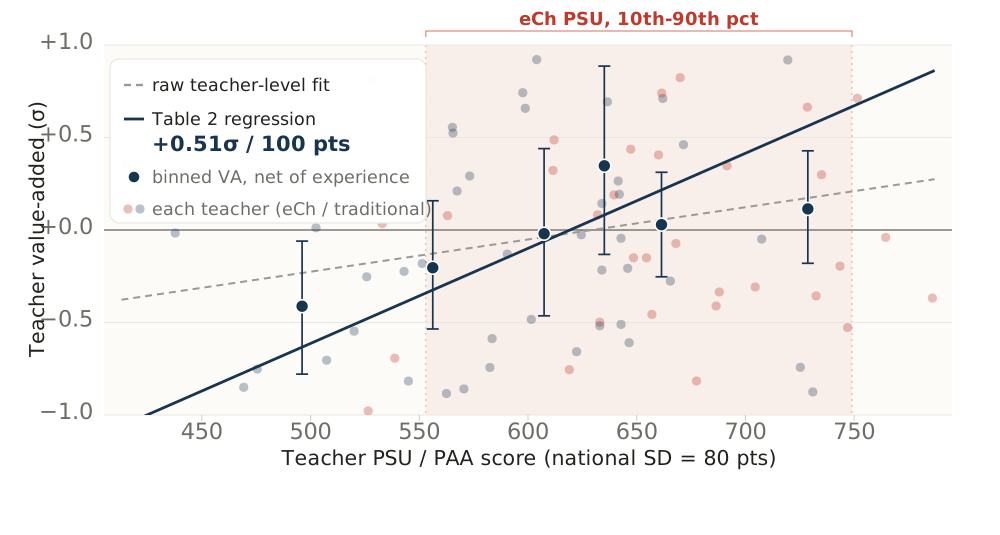
Teachers who scored higher on the PSU/PAA university entrance exam before they ever entered a classroom produce larger learning gains. The gradient is 0.51σ of value-added per 100 exam points, which is 0.41σ per standard deviation of teacher ability, since one standard deviation of the teacher ability distribution is about 80 points.
The decomposition
After reweighting the comparison teachers to the national common-support ability distribution.
Ability contribution
Inexperience penalty
Route remainder (implied)
Net gap (implied)
Net gap = ability + inexperience + route remainder: −0.16σ = +0.25σ + −0.30σ + −0.10σ
The −0.16σ net gap is itself not statistically distinguishable from zero. What the paper identifies is its composition.
The finding in 90 seconds
Enseña Chile places university graduates in classrooms after a short preparation programme rather than a traditional teacher-education degree. Comparing their students' learning gains to those of traditionally prepared teachers gives a raw gap of −0.32σ in mathematics: Enseña Chile teachers at −0.19σ, traditional teachers at +0.13σ (s.e. 0.16, p = 0.04). Read on its own, that number looks like a verdict on the route.
It is not, because two other things differ at the same time. Enseña Chile recruits sit at the 97th percentile of the national teacher ability distribution — +1.9 SD above the mean teacher on the PSU/PAA university entrance exam — and ability predicts effectiveness: 0.51σ of value-added per 100 exam points, equivalently 0.41σ per standard deviation of teacher ability, where one teacher SD is about 80 points. And every Enseña Chile teacher in the sample is in their first or second year. Experience matters enormously early on: first-year Enseña Chile teachers are at −0.47σ, second-year at +0.13σ, a difference of +0.60σ. Traditional teachers show a flat profile by comparison, +0.12σ early-career against +0.14σ veteran.
Reweighting the comparison group onto the same ability distribution and separating those two forces leaves a net gap of −0.16σ made of ability +0.25σ [+0.06, +0.42], inexperience −0.30σ [−0.55, −0.09], and a route remainder of −0.10σ [−0.37, +0.17]. The remainder crosses zero: net of who these teachers were before they were hired and how long they have taught, no route penalty is detectable. That is a failure to detect, not a demonstration of equivalence — the interval is wide.
The study at a glance
- Students
- 3,756
- Classrooms
- 169
- Mathematics teachers
- 114
- Enseña Chile / traditional
- 37 / 77
- Schools
- 59
- Grades, year
- 9–11, 2016